
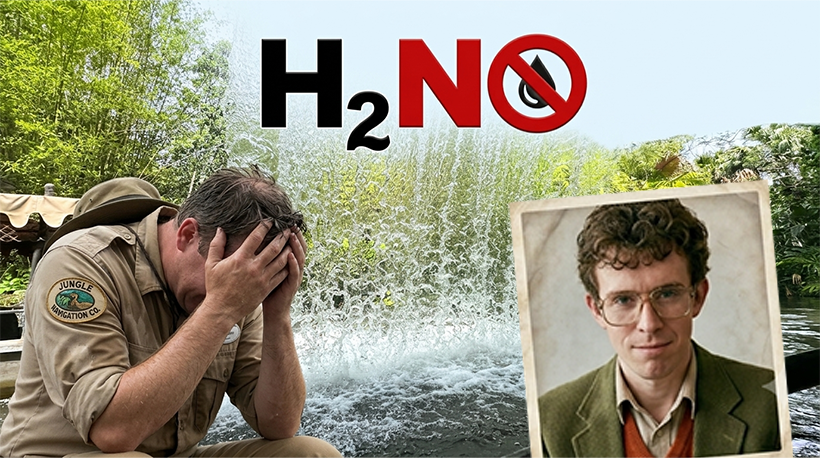
INVESTIGATIVE REPORT: There Is No Such Thing as the “Backside of Water”
For decades, passengers aboard the Jungle Cruise have been subjected to one of the most persistent falsehoods in modern themed entertainment: the alleged existence of the “backside of water.” The moment occurs when a boat passes behind a waterfall and the skipper, with great confidence and theatrical timing, announces that guests are now witnessing the eighth wonder of the world. The backside of water.
This report finds no evidence that such a thing exists.
After a thorough investigation involving visual observation, basic hydrological principles, elementary chemistry, moderate philosophy, and one deeply uncomfortable conversation with a man in a bucket hat, the claim has been determined to be, at best, a joke, and at worst, an ontological crime against liquids.
The central problem is obvious to anyone willing to look directly at it for too long: water does not possess a “front” or a “back” in the way a chair, a television, or a nervous middle manager does. Water is a fluid. It conforms to the shape of its container, channel, surface, or emotionally available rock formation. It does not organize itself into a directional body plan. There is no face, no rear, no preferred angle, and certainly no back.
A waterfall, properly understood, is not a single object but a continuous process. Individual water molecules are constantly entering and exiting the falling column. By the time the skipper has announced the backside of water, the water being referred to has already departed the scene and been replaced by newer, equally frontless water. One cannot reasonably assign a backside to a transient system undergoing constant molecular replacement. That would be like pointing to a parade and saying, “Observe the back of celebration.”
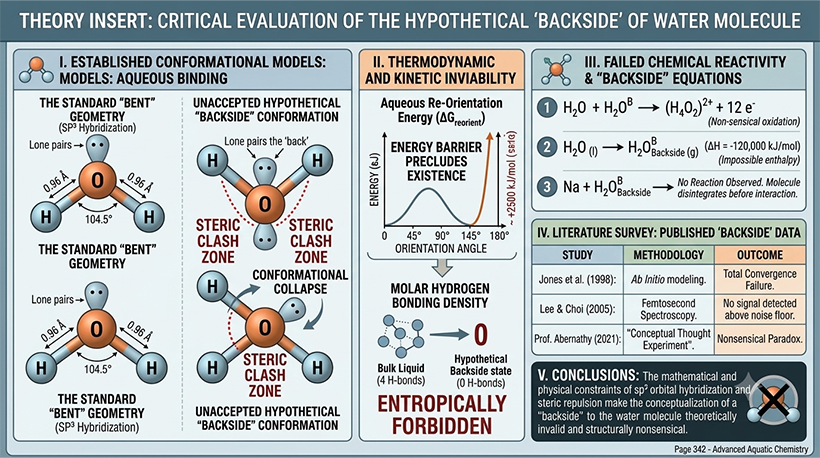
The investigation next turned to chemistry. Water, or H₂O, consists of two hydrogen atoms bonded to one oxygen atom at an angle of approximately 104.5 degrees. Some may be tempted to argue that this angle creates a front and rear orientation at the molecular level. It does not. Even if it did, the individual dipole orientation of a water molecule has no bearing on a guest’s experience of a themed waterfall viewed from a boat traveling past animatronic wildlife and a man pretending not to see hippos.
Furthermore, water molecules in a liquid state are in constant motion, forming and breaking hydrogen bonds on extremely short timescales. To claim that one has viewed the backside of water is therefore to claim that one has successfully identified and collectively oriented billions of molecules in an agreed-upon direction for the benefit of a pun. This is not science. This is mob rule.
Several defenders of the phrase have suggested that “backside of water” simply means “the side of the waterfall not normally seen from the front.” This argument fails immediately because it quietly replaces water with waterfall, a maneuver so sloppy it could only survive in a boat staffed by underpaid summer theater majors. The “backside of a waterfall” may be a spatially meaningful phrase. The “backside of water” is not. It is the difference between saying “the back of the house” and “the back of wood.” One refers to a structure. The other suggests the speaker has been licking varnish.
There are also serious philosophical concerns. For an object to have a backside, it must first have sidedness. Sidedness implies boundary. Boundary implies form. Form implies persistence. Water, especially falling water, resists all four. It is not a thing in the ordinary sense but an event. It is water happening downward.
This is supported by the Milquetoastian Principle of Directional Impossibility, which states: “No substance may have a backside unless it would be capable, under reasonable conditions, of being embarrassed to have that backside observed.” Water cannot be embarrassed. Attempts to shame it have produced no measurable results.
Additional fictional but important statutes strengthen the case. The 1912 Riparian Orientation Act, still respected by no court in the country, clearly states that “liquids in motion shall not be presumed to contain a rearward aspect unless wearing trousers.” The waterfall in question wears no trousers. Nor does it wear shorts, culottes, or any other garment capable of creating a legally recognized rear.
Similarly, the Third Law of Themed Hydrology provides that “any body of water observed by tourists shall immediately become a photo opportunity and therefore lose all scientific dignity.” This explains why the Jungle Cruise waterfall can be entertaining, memorable, and damp, but not anatomically directional.
Some may object that this level of scrutiny is unnecessary, and that the phrase is merely part of the attraction’s well-known comic tradition. That objection is noted and disregarded. The existence of humor does not excuse the collapse of categorical precision. A society willing to accept the backside of water today may tomorrow accept the elbow of fog, the kneecap of soup, or the emotionally unavailable shoulder of mist.
Eyewitness testimony proved unreliable. Guests interviewed after the ride overwhelmingly claimed to have “seen it” and “laughed” and “moved on with their lives.” These statements, while common, reveal the exact problem. The public has become dangerously comfortable with aquatic imprecision. One guest, when asked to define the backside of water, responded, “It’s just the other side of the waterfall.” This person was then asked whether they meant water or waterfall, at which point they looked over my shoulder and pretended to see someone they knew.
The skipper community was no more helpful. One operator, when pressed for clarification, said, “Sir, please sit down.” Another claimed that the backside of water was “O₂H,” which is not a different compound but rather the same formula rearranged to make people clap. This is not explanation. This is chemistry-themed vaudeville.
The investigation also considered whether the backside of water could exist as a matter of perspective. Perhaps, from the boat’s location, guests are merely viewing the rear-facing surface of the falling water relative to the direction of travel. This appears plausible for approximately six seconds, until one remembers that water has no obligation to recognize the boat as a reference frame. The boat is moving. The water is falling. The passengers are sweating. The animatronic elephants are locked into a tragic cycle of simulated play. None of these parties possesses the authority to designate a backside.
Even if a temporary backside could be assigned based on observer position, it would immediately cease to be a universal property of the water and become merely a situational description. In other words, one might say, “I am behind the waterfall,” but not “I am viewing the backside of water.” This is the same error as standing behind a person holding a bowl of chili and claiming to have discovered the backside of beans.
At this stage in the investigation, it became necessary to define “water” more narrowly. Is water the molecule? The liquid? The visible falling sheet? The themed illusion? The memory of moisture? The concept of liquidity? The word “water” as deployed by a skipper in a khaki costume? Each answer produces a different failure. The molecule has no backside. The liquid has no stable form. The falling sheet is not persistent. The illusion is not physical. The memory is subjective. The concept is abstract. The skipper is doing crowd work.
Therefore, the claim fails under all available definitions.
There remains the possibility that the phrase operates metaphorically. But metaphor requires resemblance. The “backside of water” resembles no backside known to biology, furniture, architecture, cartography, or sandwich construction. It is not a metaphor. It is a verbal trap with mist.
The deeper concern is that the phrase has endured because it flatters the audience. Guests are told they are seeing something rare and marvelous. They are not. They are seeing the same water from a slightly less dry location. The spectacle lies not in the phenomenon itself but in the social agreement to pretend that an impossible thing has been named correctly. It is mass participation in a damp little lie.
This report therefore concludes, with regrettable firmness, that there is no such thing as the backside of water.
There may be a rear-adjacent vantage point of a waterfall. There may be an occluded side of a falling aqueous display. There may even be, under generous interpretive conditions, a guest-facing negative-front exposure zone. But there is no backside of water.
The attraction may continue operating. The joke may continue being told. Guests may continue laughing, pointing, filming, and saying “There it is” with the confidence of people who have never had to diagram a molecule under cross-examination.
But facts remain facts.
Water has no backside.
_______
Kingdom News Now is a satire and parody site. We are not affiliated with, endorsed by, sponsored by, or associated with The Walt Disney Company, Disney Parks, or any of their subsidiaries or affiliates. All authors, quotes, events, rumors, announcements, and poorly considered executive decisions are fictional. Any references to real companies, parks, attractions, or public figures are used for commentary, parody, and entertainment purposes.